
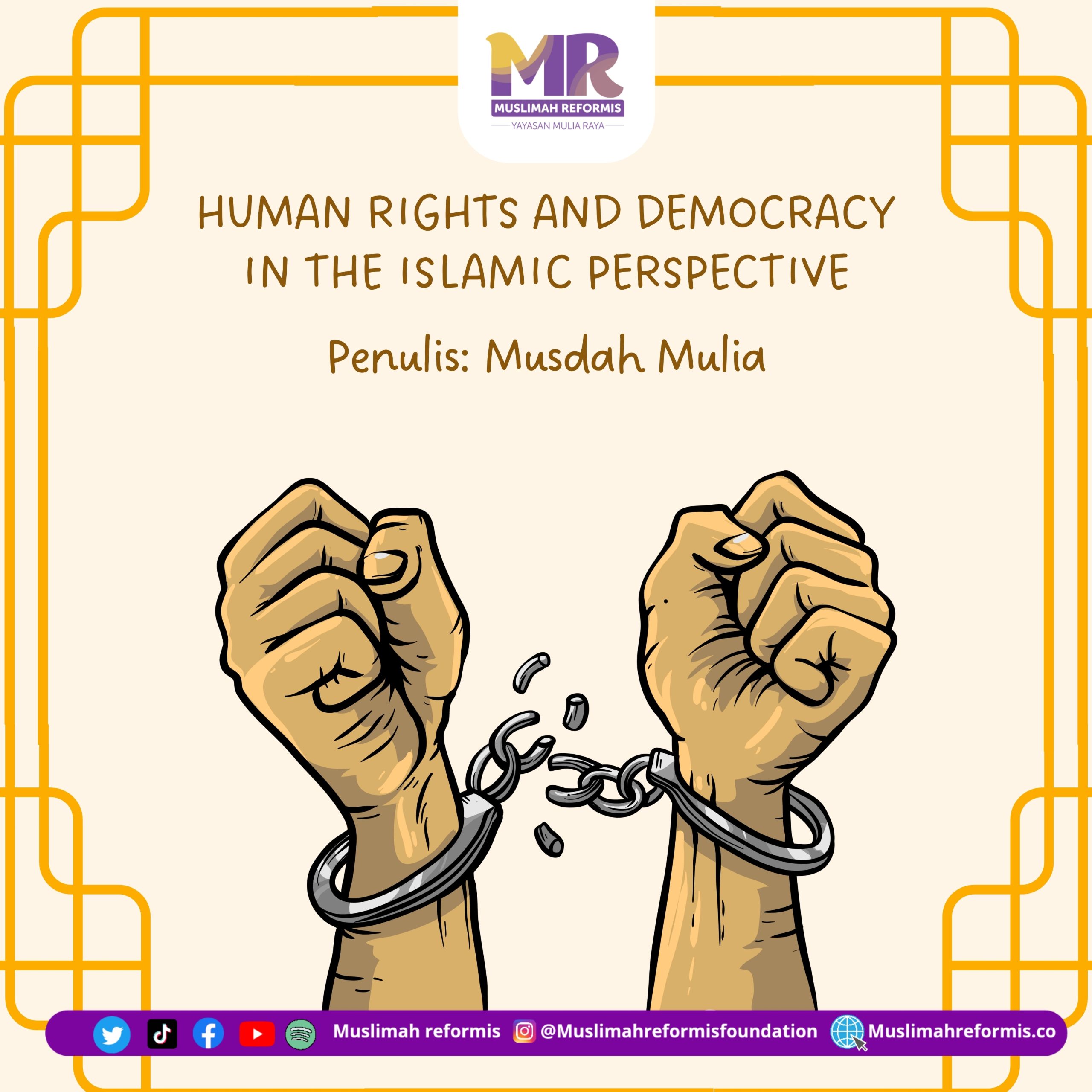
HUMAN RIGHTS AND DEMOCRACY IN THE ISLAMIC PERSPECTIVE
Musdah Mulia
- Introduction
Human rights and democracy constitute two of the defining pillars of modern civilization. They have become fundamental indicators of the quality of a nation’s political life, social order, and commitment to human dignity.
Yet within many global discussions, Islam is frequently questioned in relation to democracy, pluralism, and the protection of human rights. Such questions often arise from political realities in several Muslim-majority societies where authoritarian governance, gender discrimination, violence committed in the name of religion, and restrictions on civil liberties continue to persist.
It is crucial, however, to distinguish between the normative teachings of Islam and the political practices of Muslim societies. Contemporary Muslim scholars have repeatedly emphasized that the ethical foundations of human rights and democracy are not foreign to Islam; rather, they are deeply rooted within its moral vision.
Islam emerged with a transformative mission: to liberate human beings from oppression, to uphold human dignity, to advance social justice, and to reject every form of domination and dehumanization. From the Islamic perspective, every human being is inherently endowed with dignity and possesses fundamental rights that deserve protection and respect. The Qur’an proclaims: “Indeed, We have honored the children of Adam” (Qur’an 17:70).
This verse affirms a profound and universal principle: human dignity does not depend upon race, religion, ethnicity, gender, nationality, or social status. It belongs to all members of the human family simply because they are human. This moral recognition forms one of the most important foundations for the development of a human rights framework within Islam.
- Foundations of Human Rights in Islam
The concept of human rights in Islam can be traced through the fundamental objectives of Islamic law, which are intended to safeguard and nurture human life. Within the Islamic legal tradition, this framework is known as maqāṣid al-sharī‘ah, the higher objectives of the Sharia.
According to the classical formulation developed by scholars such as Abu Ishaq al-Shatibi, Islamic law seeks to protect at least five essential values: religion, life, intellect, family lineage, and property. In contemporary developments, this framework has been expanded to include the protection of human dignity, freedom, justice, and the socio-political rights of citizens. Such an expansion reflects the dynamic and ethical spirit of Islam as a living moral tradition that continuously responds to the evolving needs of humanity.
Islam also affirms the principle of religious freedom. The Qur’an unequivocally states: “There shall be no compulsion in religion” (Qur’an 2:256). This verse serves as a powerful foundation for freedom of conscience and freedom of belief. Faith cannot be created through coercion, intimidation, or state authority. Genuine belief can only emerge from personal conviction and moral freedom.
Equally central to Islamic ethics is the principle of justice (al-‘adl).The Qur’an commands believers to uphold justice even toward those who are different from them, or even toward those whom they dislike. Justice in Islam is therefore not tribal, sectarian, or exclusive. It transcends boundaries of identity and affiliation, affirming that fairness and dignity belong equally to all human beings.
At its deepest level, the Islamic commitment to justice is not merely a legal obligation but a moral responsibility to protect the vulnerable, restrain power, and preserve the humanity of others. In this sense, human rights are not external imports into Islamic thought; they are part of Islam’s enduring ethical struggle to ensure that every person may live with dignity, freedom, and hope.
III. Is Islam Contrary to Democracy?
The overwhelming majority of progressive Muslim scholars answer this question with a clear and confident no. Islam and democracy are not natural adversaries. On the contrary, many of the ethical foundations that sustain democratic life: consultation, justice, accountability, resistance to tyranny, and respect for human dignity are deeply embedded within Islamic teachings.
The difficulties experienced by many Muslim-majority countries in establishing robust democratic institutions and protecting human rights cannot simply be attributed to Islam itself. Rather, these challenges are largely rooted in historical and structural realities, including the legacy of colonialism, authoritarian political systems, and monopolization of religious interpretation, patriarchal cultures, weak legal institutions, and persistent geopolitical conflicts.
The problem, therefore, is primarily historical, political, and institutional rather than theological. One of the most urgent tasks facing contemporary Muslim societies is the development of interpretations of Islam that are democratic, humanistic, pluralistic, and committed to gender justice. Equally important is the strengthening of democratic institutions capable of protecting the dignity and rights of every citizen without distinction.
The central question of our time is not whether Islam can coexist with democracy, but whether Muslim societies are willing to recover the emancipatory ethical vision that lies at the heart of their own religious tradition.
IV. Democracy and the Principle of Consultation (Shūrā) in Islam
Although the term democracy does not explicitly appear in the Qur’an, many democratic values resonate strongly with Islamic teachings.
One of the most important among them is the principle of shūrā, or consultation. The Qur’an praises communities whose affairs are conducted through collective deliberation: “Their affairs are conducted through consultation among themselves” (Qur’an 42:38).
This principle reflects a profound rejection of absolutism and authoritarian rule. Political power should never be concentrated in the hands of a single individual or institution without accountability. Decisions affecting society must emerge from participation, dialogue, and collective wisdom.
Modern Muslim thinkers such as Abdullahi Ahmed An-Na’im, Fazlur Rahman, and Nurcholish Madjid have argued that modern democracy can serve as a political instrument compatible with the moral objectives of Islam.
According to them, democracy offers mechanisms for limiting political power, protecting minorities, ensuring public participation, and preventing tyranny. Within this understanding, democracy should not be viewed as a threat to religion, but rather as an ethical framework through which justice and public welfare may be realized.
Democracy, at its best, is not merely a procedure for electing governments. It is a moral commitment to the equal worth of every human being and to the conviction that no person should be denied a voice in shaping the society in which they live.
V. Islam and Freedom of Religion
Islam recognizes human diversity not as an accident of history, but as part of God’s own design for humanity. The Qur’an declares: “Had your Lord willed, all the people on earth would have believed together” (Qur’an 10:99).
This verse reminds believers that plurality is not a failure of faith but an expression of divine wisdom. Human diversity, in belief, culture, ethnicity, and worldview, is woven into the fabric of creation itself.
Consequently, coercion in matters of faith stands in contradiction to one of Islam’s most fundamental ethical principles: freedom of conscience.
In pluralistic societies, religious freedom is indispensable for democracy, peaceful coexistence, and social harmony. Progressive Muslim thinkers in Indonesia have consistently argued that the state must never employ religion as an instrument for discrimination against minorities or those who hold different beliefs.
Such a principle becomes increasingly important in a world marked by the rise of identity politics, intolerance, and religious polarization.
Interreligious dialogue and global human solidarity are no longer optional ideals; they are moral necessities for the survival of peaceful societies.
To defend another person’s freedom to believe differently is not to weaken one’s own faith. Rather, it is to affirm the sacred dignity of human conscience and to acknowledge that faith, to be meaningful, must always remain free.
In this sense, religious freedom is not simply a political right. It is an expression of our shared humanity and our collective responsibility to protect one another’s dignity in an increasingly divided world.
VI. Women and Gender Equality
One of the most significant issues in contemporary human rights discourse concerns gender relations. At its normative and ethical core, Islam affirms the spiritual equality of women and men.
The Qur’an declares: “Indeed, Muslim men and Muslim women, believing men and believing women, devout men and devout women… God has prepared for all of them forgiveness and a great reward” (Qur’an 33:35). This verse leaves little room for doubt: women and men stand before God with equal moral worth and equal spiritual responsibility. Human dignity is not determined by gender but by one’s ethical commitment and humanity.
Yet throughout history, patriarchal interpretations have frequently restricted women’s rights in social, political, legal, and religious spheres. Many norms that are often presented as immutable religious teachings are, upon closer examination, products of historical power relations and patriarchal cultural constructions rather than the essence of Islam itself.
For this reason, Muslim feminist scholars such as Amina Wadud, Fatima Mernissi, and Musdah Mulia have called for gender-just reinterpretations of religious texts. Their work is rooted in a simple yet profound conviction: the central message of Islam is justice, compassion, and respect for human dignity not the subordination of women.
The struggle for gender equality, therefore, should not be understood as a rejection of religion, but as an effort to recover religion’s own liberating ethical spirit.
When women are denied education, excluded from leadership, or silenced in the name of religion, society loses not only their voices but also their wisdom, creativity, and moral leadership. A society that marginalizes women ultimately impoverishes its own humanity. Conversely, a society that honors women as equal partners in shaping public life strengthens the very foundations of justice, democracy, and peace.
VII. Challenges to Human Rights and Democracy in the Muslim World
Although Islamic ethical teachings contain strong foundations for human rights and democracy, many Muslim-majority countries continue to face serious challenges, including authoritarianism, corruption and religious extremism, intolerance, and gender discrimination. These realities, however, should not be hastily interpreted as evidence of Islam’s failure.
Numerous scholars argue that the roots of these problems lie primarily in colonial legacies, authoritarian political structures, monopolization of religious interpretation, and the interests of political elites. In such circumstances, religion is often instrumentalized to preserve power and silence dissent.
Why does religion so easily become a tool of political legitimacy? Partly because God and the Prophet cannot be summoned into contemporary political debates to verify the claims made in their names. As a consequence, those who speak in the name of religion often acquire enormous authority to define orthodoxy, determine loyalty, and delegitimize criticism.
The challenge facing Muslim societies today is therefore not merely political reform, but the reconstruction of religious traditions that are democratic, humanistic, pluralistic, and committed to gender justice.
Indonesia occupies a particularly important place within the global conversation on Islam and democracy. As the world’s largest Muslim-majority nation, Indonesia demonstrates that Islam can coexist with democracy, pluralism, and cultural diversity.
Prominent intellectual figures such as Abdurrahman Wahid, Nurcholish Madjid, and Ahmad Syafii Maarif have played crucial roles in nurturing an inclusive and tolerant understanding of Islam.
Indonesia continues to face challenges arising from intolerance and identity politics. Nevertheless, the Indonesian democratic experience remains an important example for the Muslim world, demonstrating the possibility of harmonizing Islam, human rights, and democracy. The difficulties encountered by Muslim-majority societies in advancing democracy and human rights are extraordinarily complex and cannot be reduced to simplistic accusations against religion itself.
Political scientists and contemporary Islamic scholars generally agree that the obstacles to democracy in many Muslim societies are more closely related to structures of power and historical circumstances than to Islamic doctrine.
1. The Legacy of Political Authoritarianism
Many contemporary Muslim states emerged from histories shaped by absolute monarchies, military regimes, or highly centralized postcolonial governments. Consequently, political cultures that developed in these societies often emphasized obedience to rulers rather than active civic participation.
Examples can be found in absolute monarchies in the Middle East, military governments in Egypt, and one-party systems in several Muslim-majority countries. Under such conditions, political opposition is restricted, independent media are silenced, and civil society organizations are weakened.
Democracy struggles to flourish where the state becomes overwhelmingly dominant and political power escapes meaningful accountability. The challenge, therefore, lies not in religion but in creating political cultures that encourage participation, transparency, and shared responsibility.
2. The Legacy of Colonialism
Most Muslim-majority countries experienced European colonial domination under powers such as Britain, France, and the Netherlands.
Colonialism left behind deep economic inequalities, contested national borders, identity conflicts, and bureaucratic institutions designed more for control than for participation.
After independence, many national elites inherited and preserved these centralized and repressive state structures. As a result, the state often remained stronger than society itself, while democratic institutions and human rights protections failed to develop organically. The shadow of colonialism continues to shape political realities long after formal independence has been achieved.
3. The Political Instrumentalization of Religion
In many Muslim societies, religion has frequently been used as a tool of political legitimacy. Political leaders may invoke religious symbols and language to strengthen their authority, silence criticism, or portray opponents as enemies of religion.
Under such circumstances, religious interpretation becomes monopolized by the state, critical thinking is discouraged, and freedom of expression is constrained.
Yet classical Islamic civilization itself was characterized by vibrant intellectual debates, rich theological diversity, and traditions of critical inquiry. The problem is therefore not religion, but the use of religion as an instrument of power. Whenever faith becomes a political weapon, both religion and democracy suffer together.
4. Patriarchal and Conservative Interpretations
Many Muslim societies continue to be deeply influenced by patriarchal traditions, feudal social structures, and conservative religious interpretations. As a consequence, women’s rights are often restricted, freedom of expression becomes suspect, pluralism is perceived as a threat, and minority communities remain vulnerable.
Yet many of Islam’s foundational values support justice, consultation, compassion, and respect for human dignity. The challenge frequently lies not within the sacred texts themselves, but within interpretations that emerged within patriarchal structures of power.
To distinguish between divine ethical principles and historical human interpretations is one of the most important intellectual responsibilities of contemporary Muslim scholarship.
5. Weak Democratic Institutions
Democracy requires far more than elections. Healthy democracies depend upon independent courts, free media, critical education, vibrant civil society organizations, and cultures of accountability.
In many Muslim-majority countries, however, judicial institutions remain vulnerable to political influence, corruption remains widespread, and economic oligarchies exercise disproportionate power. As a result, democracy may survive procedurally while failing substantively. Without strong institutions, human rights become fragile and vulnerable to political interests.
6. Identity Politics and Extremism
Global geopolitical conflicts have further complicated democratic development in many Muslim societies. Wars, foreign interventions, sectarian conflicts, and radical movements often create environments of fear and instability. In such conditions, religion can easily be mobilized for identity politics.
Democracy may then be portrayed as a threat, human rights dismissed as “Western products,” and criticism interpreted as hostility toward religion itself. Yet many principles of human rights resonate profoundly with Islamic ethical teachings: justice, protection of life, equality of human beings, and resistance against tyranny. The task before Muslim societies is not to reject universal values, but to recognize their deep resonance within Islamic moral traditions.
7. Economic Inequality and Educational Disparities
Societies marked by severe economic inequality often face greater difficulties in building healthy democracies. High unemployment, weak educational systems, and concentrations of wealth among small elites create conditions in which emotional mobilization becomes easier than rational public deliberation.
Substantive democracy requires citizens who possess not only political rights but also access to education, economic opportunity, and social mobility. Democracy flourishes when dignity is not a privilege reserved for the few but a shared reality for all.
8. Fear of Western Secularism
Historical experiences of colonial domination have left deep wounds within many Muslim communities. As a result, concepts such as democracy, liberalism, and human rights are sometimes viewed with suspicion, perceived as instruments of Western cultural domination rather than universal ethical aspirations.
This historical memory has often produced defensive responses toward global human rights discourse. Yet many contemporary Muslim scholars have demonstrated that human rights need not conflict with Islam and that democratic values can emerge authentically from within Islamic ethical traditions themselves.
The future of democracy in Muslim societies may therefore depend not on importing foreign models, but on rediscovering the emancipatory resources that have long existed within their own intellectual and spiritual heritage.
VIII. Strategic Pathways toward Renewal and Transformation
1. Developing Humanistic and Democratic Interpretations of Islam
One of the most urgent tasks facing contemporary Muslim societies is the cultivation of interpretations of Islam that are inclusive, rational, pluralistic, and committed to gender justice.
More importantly, such interpretations must not remain confined to academic circles; they must become part of mainstream religious understanding and public consciousness.
Religious leaders, particularly women religious scholars and leaders, have a crucial responsibility to reject extremism, oppose the use of religion to justify violence, and affirm that Islam fundamentally upholds and protects human dignity. The future of Muslim societies may well depend on their ability to present Islam not as an ideology of exclusion, but as a moral force for liberation, justice, and compassion.
2. Preventing the Political Monopoly of Religion
Governments must cease using religion as an instrument for legitimizing political power. When religion becomes monopolized by the state, criticism is treated as sin, opposition is portrayed as hostility toward faith, and freedom of thought becomes vulnerable to repression.
The goal is not to remove religion from public life. Rather, it is to build a state that treats all citizens fairly, protects freedom of religion, and prevents the manipulation of faith for political interests.
Democracy can only flourish when citizens are free to question authority, when the law applies equally to all, and when religion is not used to silence differences of opinion. A faith that is confident in its moral truth does not fear freedom.
3. Strengthening Critical Education and Democratic Literacy
Education is the cornerstone of democracy. Many educational systems continue to rely excessively on dogmatism, discourage critical inquiry, and fail to nurture intellectual freedom.
For this reason, educational reform is essential: strengthening scientific inquiry, human rights education, civic education, and interreligious dialogue.
Islamic education, in particular, should place greater emphasis on social ethics, human rights, equality, and public responsibility. Education should not merely produce obedient individuals; it should cultivate thoughtful citizens capable of empathy, ethical judgment, and democratic participation. The deepest purpose of education is not conformity, but human flourishing.
4. Ensuring Gender Equality
No society can build a healthy democracy while excluding half of its population from full participation. Muslim societies must eliminate legal discrimination against women, protect women’s rights to education and employment, prevent gender-based violence, and expand opportunities for women’s leadership.
Many injustices experienced by women originate not from Islam itself but from patriarchal social structures that have historically spoken in the name of religion. Scholars such as Amina Wadud and Fatima Mernissi, and Musdah Mulia have demonstrated that the Qur’an contains profound ethical commitments to justice, reciprocity, and equality. A democracy that excludes women cannot fully call itself democratic.
5. Strengthening the Rule of Law and Democratic Institutions
Democracy cannot survive through elections alone. It requires independent courts, free and responsible media, effective anti-corruption institutions, strong representative bodies, and meaningful protections for minorities.
Without the rule of law, human rights become vulnerable, corruption becomes normalized, and political power gradually drifts toward authoritarianism.
Islam itself places great emphasis on justice, accountability, and the prohibition of abuse of power.Justice is not merely a legal principle; it is the moral architecture upon which peaceful societies are built.
6. Empowering Civil Society
Civil society organizations play an indispensable role in democratic life. States must create space for women’s organizations, human rights institutions, interfaith communities, youth movements, and social initiatives to participate actively in public affairs.
A strong civil society helps monitor power, protect vulnerable communities, and strengthen democratic culture. Within this context, moderate religious organizations can serve as bridges of peace and social trust. Democracy grows strongest not in silence, but in participation.
7. Building Economic Justice
Poverty, unemployment, and economic inequality often become significant obstacles to democratic development. Governments therefore bear responsibility for promoting social justice, creating employment opportunities, expanding access to education, and reducing economic oligarchies.
Democracy rarely flourishes in societies marked by extreme inequality. Islam possesses a rich ethical tradition concerning social solidarity, wealth distribution, charity, and the protection of the vulnerable. A society cannot call itself just when prosperity accumulates in the hands of a few while many struggle merely to survive with dignity.
8. Promoting Interfaith Dialogue and a Culture of Peace
Many conflicts in Muslim societies, including Indonesia, have been intensified by sectarianism, intolerance, and identity politics. For this reason, interreligious dialogue is essential for building trust, strengthening peace, and protecting minorities.
Women religious leaders occupy a particularly strategic position in nurturing cultures of compassion, empathy, reconciliation, and social healing. They also possess a unique capacity to reform religious interpretations, strengthen critical education, promote gender justice, and resist the political manipulation of religion.
The future of Muslim societies such as Indonesia will depend greatly upon their ability to present Islam as an ethical force, a source of justice, and an energy for human liberation.
Within such a vision, democracy and human rights cease to appear as foreign imports. Instead, they emerge as integral expressions of Islam’s own moral struggle to protect human dignity and to build societies grounded in justice, peace, and shared humanity.
IX. Conclusion
At its deepest ethical foundation, Islam carries a vision of human liberation. The core values of Islam: justice, consultation, equality, compassion, and mercy, are profoundly relevant to contemporary efforts to advance human rights and strengthen democratic life.
The principal challenge does not lie within religion itself, but rather in narrow and exclusionary interpretations, patriarchal social structures, and the instrumentalization of religion for political power. For this reason, one of the most urgent responsibilities of our time falls upon religious leaders, particularly women religious leaders, as well as scholars, educators, and human rights advocates: to bring forth interpretations of religion that affirm humanity rather than diminish it.
Religion must recover its vocation as a moral force that inspires freedom rather than fear, solidarity rather than exclusion, and justice rather than domination. The ultimate purpose of this endeavor is the creation of a more harmonious civilization, one that places human dignity, peace, equality, and social justice at the center of public life.
In today’s increasingly interconnected yet deeply fragmented world, interreligious dialogue and global human solidarity have become more important than ever. Together, they offer essential resources for resisting violence, discrimination, hatred, and the many forms of dehumanization that continue to threaten democratic values and undermine fundamental human rights.
The burden of these injustices is borne most heavily by vulnerable communities, particularly women, whose voices and experiences have too often been marginalized or ignored. To defend the rights of women, minorities, and vulnerable communities is not merely a political obligation; it is a moral imperative rooted in our shared humanity.
Ultimately, the future of democracy and human rights in Muslim societies will depend not only upon constitutions, elections, or institutions, but also upon the courage to imagine religion as a source of ethical transformation and social compassion.
The question before us is therefore not whether Islam is compatible with human rights and democracy. The more urgent question is whether we, as believers, scholars, leaders, and citizens, possess the moral courage to embody the highest ethical aspirations of our own traditions.
For whenever religion stands beside the oppressed, protects the vulnerable, and speaks truth to power, it fulfills its noblest calling. And whenever human dignity is defended, regardless of faith, ethnicity, nationality, or gender, the moral vision of Islam finds one of its most beautiful expressions.
The future of our shared humanity may well depend upon our ability to choose dialogue over hatred, justice over domination, and compassion over indifference. For peace is not merely the absence of conflict. Peace is the presence of justice. And justice begins with the recognition that every human being, without exception, is worthy of dignity, freedom, and hope.
References
Abou El Fadl, K. (2004). Islam and the challenge of democracy. Princeton University Press.
Ahmed, L. (1992). Women and gender in Islam: Historical roots of a modern debate. Yale University Press.
An-Na’im, A. A. (Ed.). (1992). Human rights in cross-cultural perspectives: A quest for consensus. University of Pennsylvania Press.
Barlas, A. (2002). “Believing women” in Islam: Unreading patriarchal interpretations of the Qur’an. University of Texas Press.
Cesari, J., & Casanova, J. (Eds.). (2017). Islam, gender, and democracy in comparative perspective. Oxford University Press.
Engineer, A. A. (1992). The rights of women in Islam. C. Hurst & Company.
Engineer, A. A. (2000). Hak-hak perempuan dalam Islam. LSPPA.
Esack, F. (1997). Qur’an, liberation and pluralism: An Islamic perspective of interreligious solidarity against oppression. Oneworld.
Hassan, R. (1996). Feminism in Islam. New York University Press.
Jawad, H. A. (1998). The rights of women in Islam: An authentic approach. Macmillan Press.
Khatab, S., & Bouma, G. D. (2007). Democracy in Islam. Routledge.
Madjid, N. (1999). Cita-cita politik Islam era reformasi. Paramadina.
Mas’udi, M. F. (1997). Islam dan hak-hak reproduksi perempuan: Dialog fiqh pemberdayaan. Mizan.
Maududi, A. A. (1976). Human rights in Islam. The Islamic Foundation.
Mayer, A. E. (2019). Islam and human rights: Tradition and politics (5th ed.). Routledge.
Mernissi, F. (1997). Islam and democracy: Fear of the modern world. Addison-Wesley Publishing.
Mir-Hosseini, Z. (1999). Islam and gender: The religious debate in contemporary Iran. Princeton University Press.
Mulia, Musdah. (2005). Islam menggugat poligami. Gramedia.
—————–. (2010). Kemuliaan perempuan dalam Islam. Elex Media Komputindo.
——————– The Importance of Inter-Religious Dialogue, United Evangelical Mission (UEM), Wuppertal, Germany, 2007.
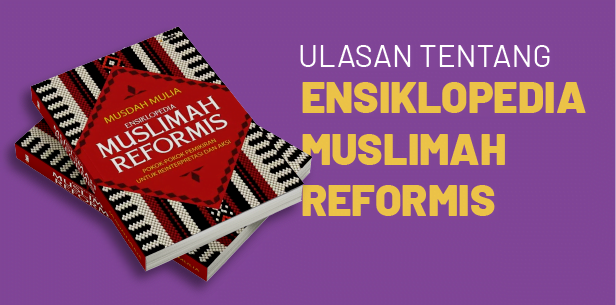
—————–. (2021). Ensiklopedia Muslimah Reformis: Pokok-pokok pemikiran untuk reinterpretasi dan aksi. BACA.
Muthahhari, M. (2009). Perempuan dan hak-haknya menurut pandangan Islam. Lentera.
Rais, A. (1995). Tauhid sosial: Formula mengatasi kesenjangan sosial. Mizan.
Robinson, K. M. (2009). Gender, Islam and democracy in Indonesia. Routledge.
Souaiaia, A. E. (2008). Contesting justice: Women, Islam, law, and society. State University of New York Press.
Sudjana, E. (1998). HAM, demokrasi, dan lingkungan hidup: Perspektif Islam. Yayasan As-Syahidah.
Wadud, A. (1999). Qur’an and woman: Rereading the sacred text from a woman’s perspective (2nd ed.). Oxford University Press.
Wahid, A. (2001). Islamku, Islam Anda, Islam Kita. Wahid Institute.
Zakaria, F. (2003). The future of freedom: Illiberal democracy at home and abroad. W. W. Norton & Company.
Zuhdi, M. (2018). Islam dan demokrasi: Pergulatan pemikiran politik Islam Indonesia. Kencana.