Upholding the Values of Human Dignity and Human Rights
Musdah Mulia
Introduction
I firmly believe that all religions come with noble humanitarian values, recognizing the inherent dignity of humankind, calling for the fulfillment of fundamental human rights, and condemning all forms of barbarism, injustice, greed, domination, discrimination, and violence.
Every religion emphasizes the importance of living simply and empathetically, avoiding excesses and upholding justice. Individuals are encouraged to acquire wealth, but not for hoarding or displaying it through a luxurious lifestyle; rather, wealth should be distributed to those in need in order to eliminate injustice and social inequality.
The Paradox of Religiosity
Before delving deeper into the discourse on human dignity and human rights, allow me to invite us to reflect on the findings of the Pew Research Centre, which in recent years have revealed a paradoxical sociological reality: that countries where the majority of people identify as religious are often marked by high rates of crime, rampant corruption, and persistent social conflict.
Take, for instance, three Asian countries that have recently attracted wide public attention: Indonesia, with over 90% of its population identifying as Muslim; Nepal, where more than 80% identify as Hindu; and the Philippines, where over 80% identify as Catholic. In these countries, public anger has erupted in response to widespread injustice and inequality, aggravated by corrupt officials flaunting extravagant lifestyles while the majority of citizens live in poverty and marginalization.
Religion in Indonesian Context
In the case of Indonesia, this paradox is particularly evident. Almost all surveys show that the majority of Indonesians consider themselves devoutly religious. Magnificent places of worship dominate communities that remain economically deprived.
Religious fervor fills the public sphere, especially during Eid al-Fitr, Christmas, and other religious celebrations. Yet, at the same time, corruption is rampant, social inequality is widening, and discrimination against women and minority groups persists within law, policy, and culture. Religious-based intolerance and conflict frequently surface in the public domain.
Several explanations can be offerd, both from theological and academic perspectives:
First, religiosity is often understood as a symbolic identity, manifesting in religious attire, ritual observance, or verbal claims of piety, without an internalization of moral values. Religion, thus, remains superficial, ritualistic religiosity appearing devout while contradicting the ethical core of religion.
Second, in many religious societies, religion is often used to legitimize political power. When religion enters the political arena without accountability, it is prone to abuse justifying corruption, discrimination, and even violence. Sectarian conflict often arises not from doctrinal teachings themselves but from the politicization of religion for narrow group interests.
Third, the research also shows that poorer nations tend to be more religious compared to wealthier ones. For many in these societies, religion becomes a source of consolation, or even an intoxicating “opiate,” rather than a transformative energy for structural change.
Fourth, religious teachings are inherently rich in humanitarian and justice-oriented values. Yet when religious interpretation focuses solely on the relationship between humans and God, or ritual piety, social ethics are neglected. Hence, individuals may appear devout in worship yet still engage in corruption, domestic violence, or discriminatory practices against those of different faiths or traditions. This phenomenon reflects a deficit in public ethics: being religious but inhumane.
This sociological reality has been described as the paradox of religiosity: the higher the claim of religiosity, the greater the gap between religious symbols and social realities. I am convinced that the weakness lies not in religion itself, but in modes of religiosity that fail to prioritize moral essence, justice, and respect for human dignity.
In other words, religion is not the cause of injustice, corruption, conflict, discrimination, or crime. Rather, the problem lies in the failure to internalize religious values into social, political, and economic life. The issue is not “religion” but “religiosity” that remains superficial, trapped in identity politics, and fails to become a moral force for social transformation.
Islam and Human Dignity
What, then, does Islam contribute to the affirmation of human dignity and human rights? Islam carries a profoundly concrete humanist vision. The Qur’an asserts that humankind is created as khalīfah fil-ardh (vicegerent on earth, Qur’an 2:30), a status granted without discrimination of religion, race, ethnicity, or gender. As khalīfah, humans are entrusted as leaders and caretakers of life on earth. The Qur’an affirms the equality of all humans; dignity is determined not by wealth, position, or lineage but by taqwa, moral conduct that radiates goodness. Human mission in Islam is amar ma‘rûf nahi munkar, the pursuit of humanization and transformation, ensuring prosperity, welfare, peace, and the flourishing of all creation (rahmatan lil-‘ālamīn).
The Qur’an declares: “Indeed, We have honored the children of Adam” (Qur’an 17:70). This verse signifies that human dignity is not a state-bestowed privilege but a divine gift inherent from birth. Consequently, every human being is entitled to the protection of their dignity, irrespective of ethnicity, religion, sex or gender, or social status.
Maqāṣid al-Sharī‘ah and Human Rights
In the framework of sharī‘ah, human rights are embedded within the objectives of the law (maqāṣid al-sharī‘ah). Includes protection of the most important human rights such as the right to life, the right to freedom of religion, the right to freedom of opinion, reproductive rights, and property rights.
Thus, the protection of human rights in Islam is not a Western imposition but an integral part of faith. The Prophet Muhammad ﷺ himself affirmed: “I was only sent to perfect noble character.”
Justice and Equality as the core values of human being
The Qur’an strongly emphasizes justice: “Indeed, Allah commands justice, doing good, and giving to relatives, and forbids immorality, wrongdoing, and oppression” (Qur’an 16:90). Justice in Islam transcends formal legality; it extends to economic, social, and political justice. Hence, the accumulation of wealth by a privileged few while millions remain impoverished constitutes a betrayal of Islamic principles.
Islam also elevates the dignity of women and safeguards vulnerable groups. The Qur’an asserts that men and women are equal partners in faith and deeds (Qur’an 9:71). In his final sermon, the Prophet Muhammad urged: “Treat women well.” He also emphasized compassion toward the poor, orphans, and the oppressed. The Prophet ﷺ declared: “The best of people are those who are most beneficial to others” (Hadith, Ahmad).
Strategic steps of Upholding Human Dignity
First, Reforming Islamic interpretation and jurisprudence. A more progressive, humanist, and emancipatory hermeneutics is needed to align with the principles of human dignity and rights.
Second, Building public policies based on maqāṣid al-sharī‘ah. States must establish regulations that protect human dignity from discrimination, exploitation, and violence, especially safeguarding vulnerable groups such as women, children, the elderly, people with disabilities, and marginalized minorities.
Third, Fostering education and religious outreach that honor humanity and environmental sustainability. Younger generations must be educated with universal human values.
Fourth, Exemplary leadership by religious scholars and leaders. Fatwas, sermons, and policies must consistently uphold human dignity, reject gender and religion-based violence, and foster inclusive communities and social solidarity.
Challenges and Opportunities
I am fully aware that these four efforts are very difficult to achieve due to a number of inhibiting factors, as follows. First, rigid and patriarchal interpretation of the text. Verses on the concepts of infidel (kafir), apostasy (murtad), martyrdom (syahid), and jihad are often reduced to a very exclusive context, thus inciting hatred and hostility toward non-Muslims. Likewise, verses on polygamy, inheritance, or gender relations are often interpreted literally and legitimizing gender discrimination. Second, the politicization of religion. Political and religious elites sometimes use religion to perpetuate domination and resist change. Third, the persistence of feudal culture and hierarchical social structures. Lack of human rights literacy. A number of Islamic schools (madrasah) and Islamic boarding schools (pesantren) have not optimally taught human rights principles. As a result, the younger generation often views Islam and human rights as incompatible. Fourth, the rise of religious-based extremism, radicalism, and intolerance.
Despite the formidable obstacles we face, Muslims must remain optimistic. This is because we also have a number of supporting factors, including: First, a strong theological foundation, derived from both the Qur’an and the Sunnah of the Prophet, as well as the positive views of Islamic scholars. All of this provides solid religious legitimacy for upholding human dignity and human rights. Second, the concept of Maqāṣid al-Syarī‘ah. This concept can serve as an ethical framework for reforming Islamic law to meet the demands of the times. Third, we have many progressive contemporary Islamic thinkers who interpret Islam as a religion of justice, liberation, and emancipation. Their thinking has opened up space for the integration of Islam and human rights. Third, socio-religious movements. Muslims have a number of Islamic organizations, Islamic boarding schools, and Islamic universities that are increasingly active in mainstreaming issues of human rights, gender equality, and democracy.
Role of Interfaith Dialogue
Finally, I strongly believe that efforts to uphold human dignity and human rights are essential through a solid interfaith dialogue movement. Why? Because human dignity is universal. All religions fundamentally teach respect for humanity. Interfaith dialogue affirms that human dignity should not be viewed solely from the perspective of a particular religious identity, but rather is a universal value that transcends religious boundaries. Interfaith dialogue helps erode stereotypes, hatred, and discrimination that often lead to social conflict. Interfaith dialogue creates a more peaceful, just, and equal environment.
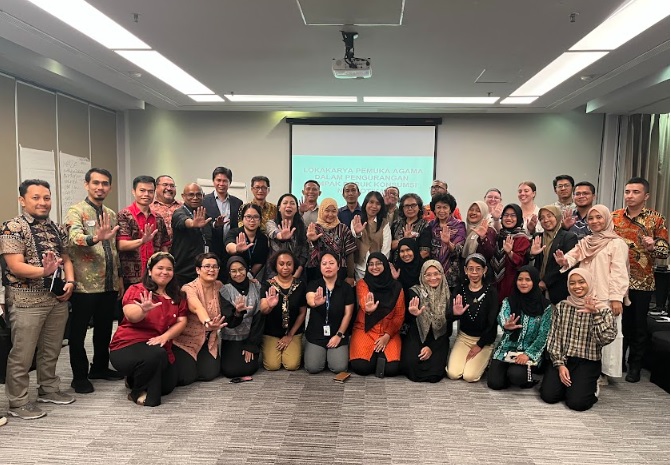
By sitting together as we are now, religious leaders can find common ground such as justice, peace, and compassion, the essence of human dignity and human rights principles. Therefore, interfaith dialogue is a strategic tool for bridging differences, building mutual understanding, and ensuring that the principles of human dignity and human rights are upheld without religious, ethnic, or cultural barriers.